
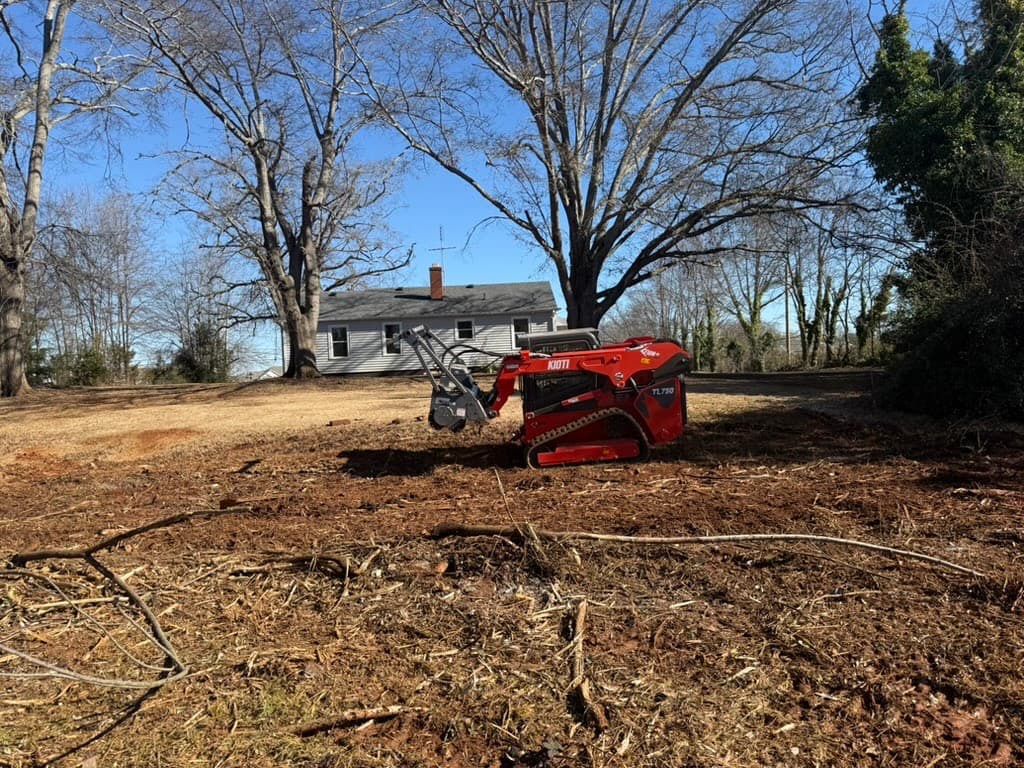
Forestry mulching has become the go-to way to clear overgrown land in the Upstate: one machine, one pass, no burn piles, no dump trucks. Here's what it actually costs per acre in 2026 across Greenville, Anderson, Pickens, Spartanburg, and Oconee counties, and how to know if it's the right method for your property.
FORESTRY MULCHING RATES IN UPSTATE SC
- Light underbrush (briars, privet, saplings under 2")$1,500 - $2,200/acre
- Medium growth (saplings 2-6", thick brush)$2,000 - $3,000/acre
- Heavy growth (trees 6-8"+, dense stands)$2,800 - $3,500+/acre
- Large jobs (5+ acres)$1,200 - $2,500/acre
- Small areas under 1 acre (flat rate)$1,500 - $2,500
Like every land service, there's a mobilization floor: getting the machine to your property costs the same whether we mulch a quarter acre or five. That's why small jobs carry a flat minimum and why per-acre pricing improves fast with size.
WHY MULCHING USUALLY BEATS TRADITIONAL CLEARING ON PRICE
Traditional land clearing knocks vegetation down, then pays again to deal with it: push it into burn piles, wait on burn windows, or load and haul it to disposal. Forestry mulching skips that entire second half:
- No hauling or disposal fees: debris becomes mulch that stays on-site
- No burn permits or smoke: a real advantage near neighborhoods
- One machine, one operator: instead of an excavator, dozer, and trucks
- Built-in erosion control: the mulch layer protects Upstate red clay from washing
- Selective clearing: keep the oaks you love, mulch everything around them
The result: for vegetation up to roughly 8 inches in diameter, mulching typically runs 20-40% less than clear-and-haul. See our full land clearing cost guide for the comparison numbers.
WHEN MULCHING ISN'T THE RIGHT TOOL
- Building pads and driveways: construction needs stumps and roots out. That's traditional clearing plus grading work.
- Large timber: trees much over 8-10 inches are slow to mulch; they're better cut and processed first.
- Bare-dirt requirements: if the spec says "grubbed and rootraked," mulch left on grade won't pass.
Most Upstate projects end up hybrid: mulch the acreage, then bring the excavator in only for the house footprint. You pay bare-dirt prices only where bare dirt matters.
WHAT AN ACRE LOOKS LIKE, JOB BY JOB
- Overgrown fence line & pasture edge, Williamston: half-acre strip of privet and sweetgum, $1,500-$2,000 flat
- 2 acres behind a home, Easley: medium brush opened into usable yard with walking trails, $4,000-$5,500
- 8-acre hunting property, Oconee County: lanes, plots, and edges mulched, $10,000-$16,000 depending on density ($1,200-$2,000/acre)
GET A MULCHING QUOTE FOR YOUR ACREAGE
Free on-site estimates across the Upstate. Tell us what's growing and we'll tell you exactly what it costs. First 10 qualified projects this season get $500 off.
FREQUENTLY ASKED QUESTIONS
How many acres can a mulcher clear per day?
Typically 1-3 acres a day in Upstate conditions. Light brush moves fast; dense saplings and slopes slow things down.
Is it cheaper than land clearing?
For growth up to ~8 inches, yes, usually 20-40% less, because there's nothing to haul, burn, or dump.
Does mulching kill the brush for good?
It cuts everything to grade; some species resprout. A follow-up mow or spot treatment the next season keeps reclaimed land clean, and the mulch layer suppresses most regrowth.
Is it safe for slopes and creek-side land?
It's the best option for them: tracked machines are low-impact, the root mat stays put, and the mulch prevents red-clay erosion.