
Two contractors quote your overgrown five acres. One says "we'll clear it," the other says "we'll mulch it," and the prices are thousands of dollars apart. They are not quoting the same job. Here's the plain-English difference between land clearing and forestry mulching, what each one costs in the Upstate, and how to pick without overpaying.
THE SHORT ANSWER
- Choose forestry mulching when you want overgrown land clean, walkable, and usable: pastures, trails, views, fence lines, hunting land, or acreage you're not building on this year. It's the cheapest way to transform land.
- Choose traditional land clearing when you need bare, root-free dirt: a house pad, driveway, septic field, pond, or anything that gets built, poured, or planted immediately.
- Most real projects combine both: mulch the bulk of the acreage, excavate only the construction footprint. That combination usually produces the lowest total bill.
WHAT EACH METHOD ACTUALLY DOES
Traditional land clearing removes vegetation from the property. Trees are cut or pushed over, stumps and root balls are dug out with an excavator, and the debris is burned on-site or hauled away. What's left is bare dirt you can grade, compact, and build on. It's the full reset, and you pay for every step of handling that material.
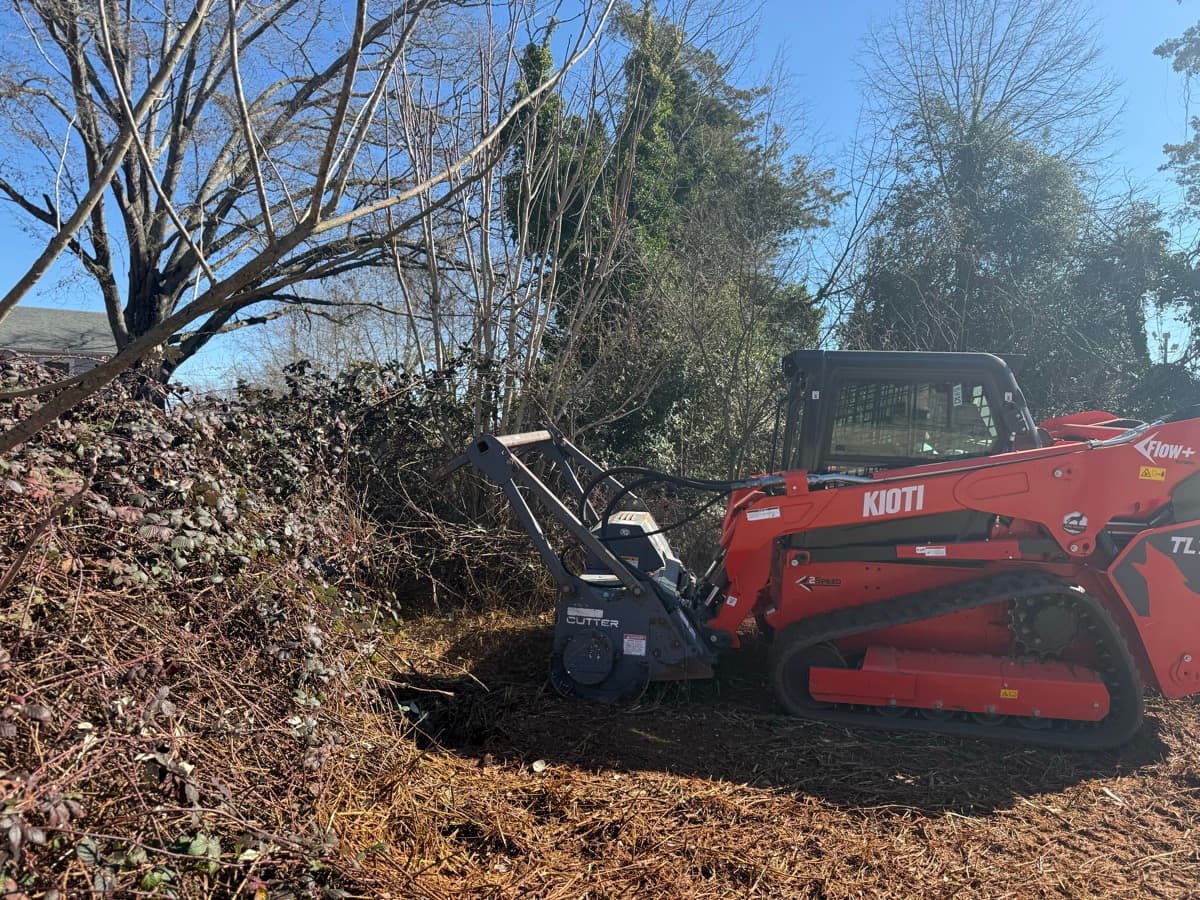
Forestry mulching uses one machine, a track skid steer with a mulching head, to grind standing trees, brush, and briars into wood chips right where they stand. Nothing leaves the property. The chips form a 2-4 inch mulch layer that suppresses regrowth, protects the soil, and slowly feeds it as it breaks down. Stumps are ground to near grade but the roots stay put.
SIDE-BY-SIDE COMPARISON
| Factor | Forestry Mulching | Traditional Clearing |
|---|---|---|
| Cost per acre (Upstate SC) | $1,500 - $2,500 | $2,500 - $5,000+ |
| What's left behind | Mulch layer, roots in soil | Bare, gradeable dirt |
| Build on it right away? | No, footprint needs grubbing | Yes, after grading |
| Hauling / burning | None | Usually required, adds cost |
| Erosion on red clay | Protected by mulch | Exposed until stabilized |
| Best tree size | Up to ~8-10" diameter | Any size |
| Speed on brush | 1-3 acres per day | Slower, more machines |
WHEN MULCHING WINS
- Reclaiming pasture or overgrown acreage: brush, briars, privet, and saplings disappear fast, and the field is walkable the same day.
- Views, trails, and fence lines: selective mulching takes out the undergrowth and leaves the trees you want.
- Hunting land: food plots, shooting lanes, and access trails without turning the woods into a mud pit.
- Land you're holding, not building on: cleared-looking land shows and sells better, and mulch keeps the regrowth down for a few seasons.
- Erosion-prone slopes: the mulch mat is the difference between a hillside and a gully after an Upstate summer storm.
WHEN TRADITIONAL CLEARING WINS
- House pads and garages: foundations need roots and stumps completely out, then compacted, graded dirt.
- Driveways and access roads: roots under a gravel or concrete drive become dips and cracks within a couple of years.
- Septic systems and utilities: trenching through mulched root mass is miserable; installers want clean soil.
- Ponds and grading projects: anything that reshapes the dirt starts with the vegetation and roots gone.
- Big timber: mature pines and hardwoods over ~10 inches are faster to cut and remove than to chew through a mulcher.
THE COMBINATION MOST UPSTATE PROJECTS USE
Say you bought 4 wooded acres outside Easley to build on. Clearing all 4 acres to bare dirt might run $12,000-$20,000. But you only need bare dirt where the house, driveway, and septic field go, maybe three-quarters of an acre. The smarter scope is traditional clearing on that footprint ($3,000-$5,000) and forestry mulching on the remaining 3+ acres ($4,500-$7,500). Same usable result, and the total lands 30-40% lower.
This is exactly how we quote it. We walk the property with you, flag the construction footprint, and price the two methods where each belongs. One crew, one mobilization, one bill. See our land clearing service and forestry mulching service pages for what each includes.
NOT SURE WHICH YOUR LAND NEEDS?
We'll walk your property, flag what needs bare dirt and what just needs mulched, and quote both. Free, across Greenville, Anderson, Pickens, Spartanburg & Oconee counties.
FREQUENTLY ASKED QUESTIONS
What's the difference between land clearing and forestry mulching?
Clearing removes vegetation, roots and all, leaving bare dirt. Mulching grinds it into wood chips that stay on the land. Clearing is a blank slate; mulching is a cleanup.
Is forestry mulching cheaper?
Usually 20-40% cheaper per acre, because there's no hauling, burning, or disposal. Full numbers in our mulching cost guide.
Can I build a house on mulched land?
Not on the mulched footprint itself. The pad, driveway, and septic area need traditional clearing so the roots come out. Mulch the rest of the property instead of clearing it all.
What are mulching's downsides?
It slows down on big timber, leaves roots in place, and the chip layer takes a few years to fully break down. For bare dirt on a deadline, clear instead.
Which handles erosion better?
Mulching, by a wide margin. The chip mat protects Upstate red clay from washouts while bare-cleared dirt needs silt fence and fast stabilization.